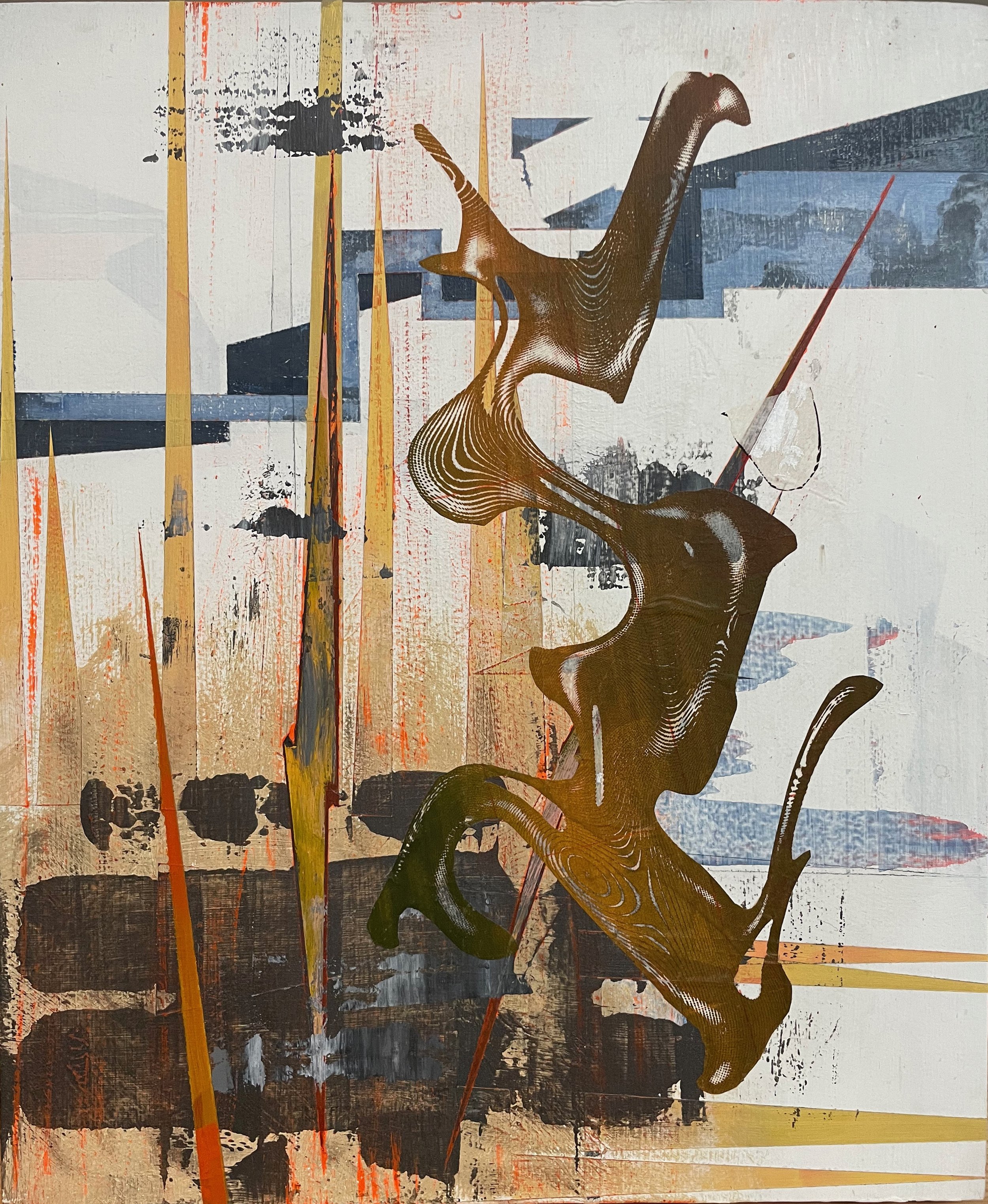
Jeffrey Bishop | Untitled WRB #1 | 2024 | Acrylic and Collage on Panel | 17 x 14 inches | Credit: courtesy of the artist
In what follows I am not attempting to echo the intentions and motivations of the artist. Rather my aim is to tease out what I see as a latent throughline winding across three distinctive series of paintings.
There’s an old expression that goes, “Don’t switch horses in the middle of a stream.” Usually a smart strategy, but what if these metaphoric “horses” were to stand in as vehicles of artistic exploration where “switching” may prove especially advantageous in generating new ideas and directions. Jeffrey Bishop is not an artist content to pursue just a single body of work, but rather he often switches back and forth, overlapping and leapfrogging among multiple series.
Here I am focusing on a handful of artworks from only three groups of his work spread out over several years, although all relatively recent in the long arc of Bishop’s artistic journey. The throughline I referred to is formally anchored by the persistence of a central form (sometimes a constellation of connected forms) that strongly evince a state of subtle or not so subtle precariousness. These forms are almost always positioned in highly dynamic environments buffeted by outer and inner perturbations.
I first want to discuss four pieces, two from a group titled The Dry Season and two from the Vulcan series. The first two paintings are strongly suggestive of imaginary landscapes due to their horizontal format (aka, “landscape mode”), their overt figure-ground organization, and a noticeable earth-sky distinction. The emotional key of these landscapes ranges from dreamy-atmospheric to something slightly more ominous—from a floating world of soft, translucent overlays to one more claustrophobic. Across this emotional spectrum I am especially intrigued by the plight of the “figures” themselves. Although they do not present as human or any biological agent, they are the focus of our attention if not our empathy. By eschewing conventional figuration Bishop offers the viewer more conceptually suggestive insights of the interactions among those central “figures” and their pressing, penetrating surroundings.
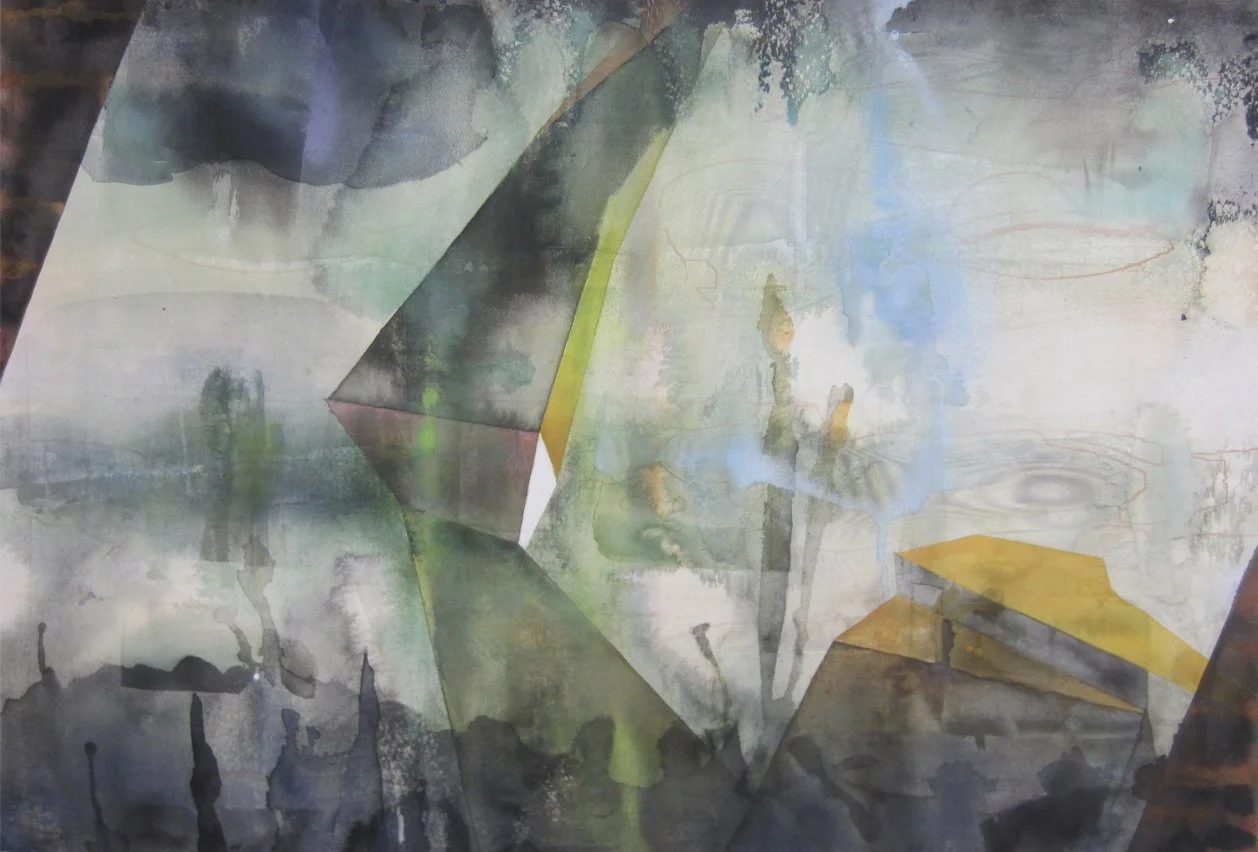
Jeffrey Bishop | The Dry Season (Ash) #2 | 2014 | Watercolor and Acrylic on Paper | 12 x 18 inches | Credit: courtesy of the artist.
Starting with the dreamy end of the pool, The Dry Season (Ash) #2 displays an intriguing visual contradiction. Here we see linked geometric forms angling their way from the bottom to the top. But unlike, say, Brancusi’s Endless Column, this chain of rhomboidal forms appears to be far less solid and formidable despite it’s imposing scale in the landscape. I find it especially interesting how the translucent films of color seem simultaneously to float in front of and to penetrate this grandiose monument to whatever. With a nod to Karl Marx, it presents the perfect visual analog of “All that is solid melts into air.”
A similar dynamic is at play with The Dry Season #8 but this time the central chain is running laterally from side to side. Again, we behold a misty, humid atmosphere but one populated with more exotic presences. The overall color space has shifted from a luminous blue & green to more muted browns. What I dimly sense in the first painting becomes more salient in this one, as the raw primitives of form, color, and composition are orchestrated to evoke a state of tenuous stability in the throws of pandemonium.
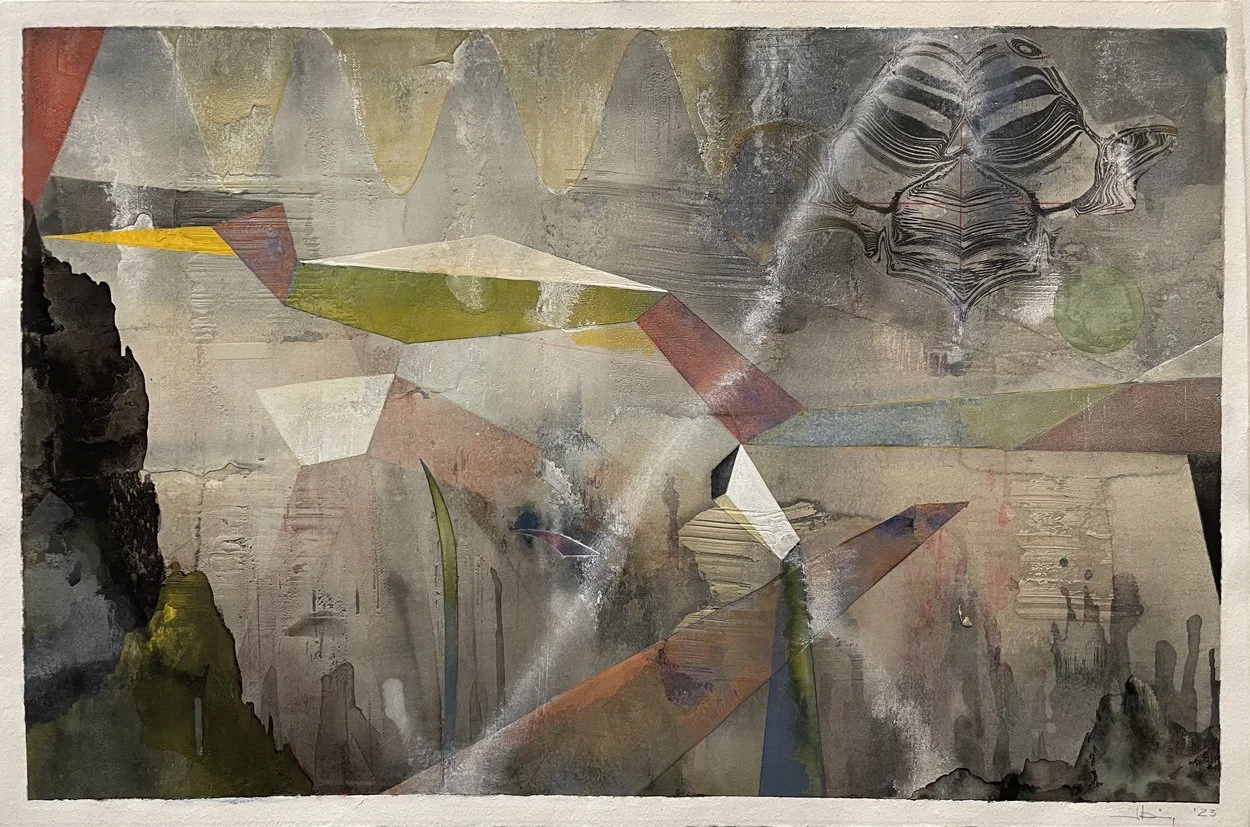
Jeffrey Bishop | The Dry Season #8 | 2023 | Watercolor and Collage on Paper | 15 x 22 inches | Credit: courtesy of the artist.
Time now to swim toward the turbulent end of the pool. Vulcan #17 (also see Vulcan #9) shares similar characteristics with the previous two, primarily the presence of a central, hard-edge, faceted geometric form. But here there is no suggestion of a landscape, and the central “figures,” rather than spanning the painting from edge to edge, are limited to the center of the composition. I suspect many viewers will liken these forms to steel-cased flying objects with an ever so slight cybertruck vibe. Paradoxically, despite all that glistening armor-like surface they are exceptionally transparent, which in this context signals their significant exposure to what appears as highly volatile environments. The enveloping atmospheres are practically vibrating, with what seems like sound waves or perhaps electromagnetic fields. Seems safe to assume that these “figures” find themselves situated in a considerably more dynamic neighborhood.
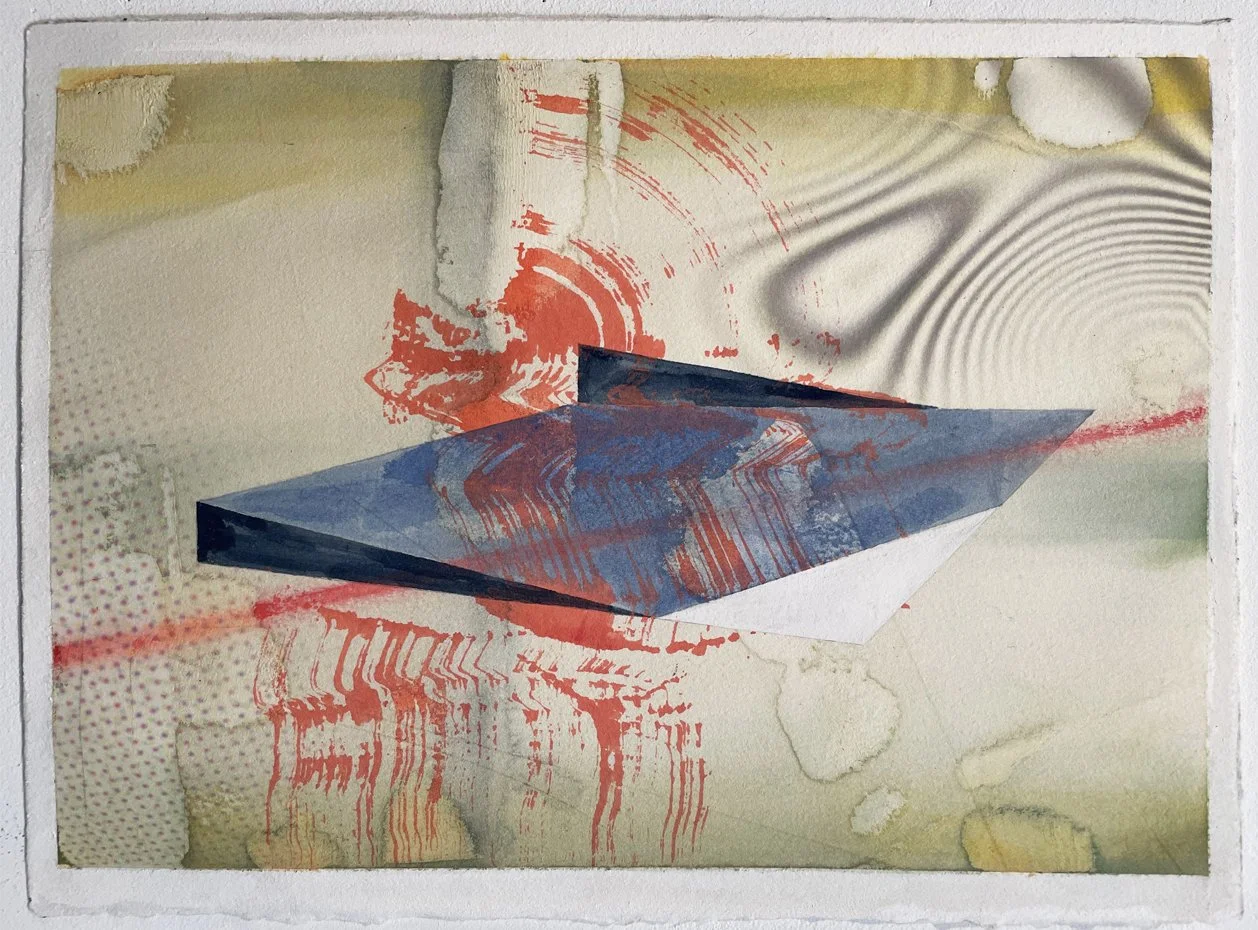
Jeffrey Bishop | Vulcan #17 | 2023 | Watercolor on Paper | 11 x 15 inches | Credit: courtesy of the artist.
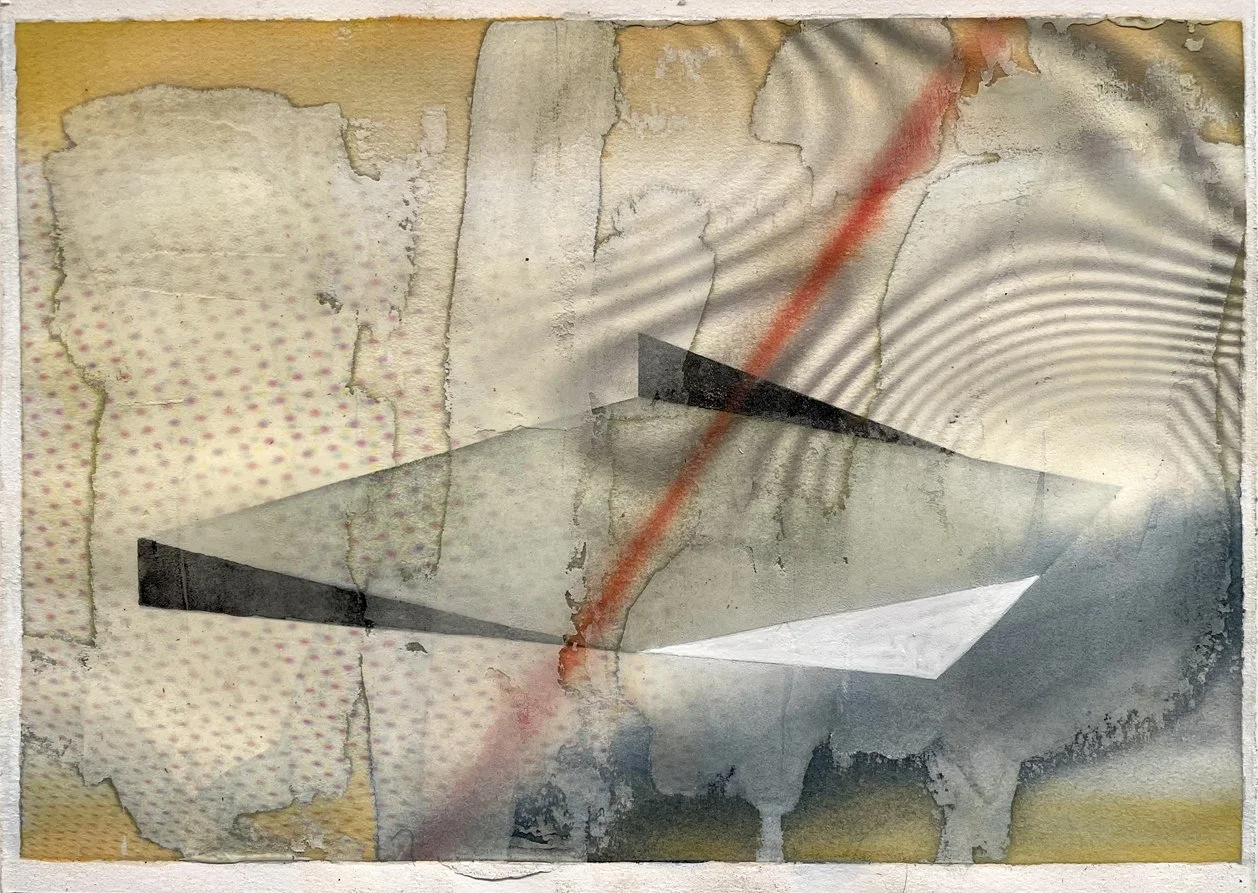
Jeffrey Bishop | Vulcan #9 | 2023 | Watercolor on Paper | 11 x 15 inches | Credit: courtesy of the artist.
Here I will confess that my pursuit of this so-called throughline is fueled by how these virtual figures present to me as stand-ins for my own (and arguably every living creatures’) all too frequent predicament of eking out a “living” in the midst of acutely pressurized environments. Entropy takes its toll, and no amount of protective armor, from skin to steel, guarantees safe passage. Of course there could be any number of other interpretations (or assertive “non interpretations”) of these works, but, regardless, I would hope that the mere possibility that wordless images can trigger viewers’ interior monologues should be celebrated.
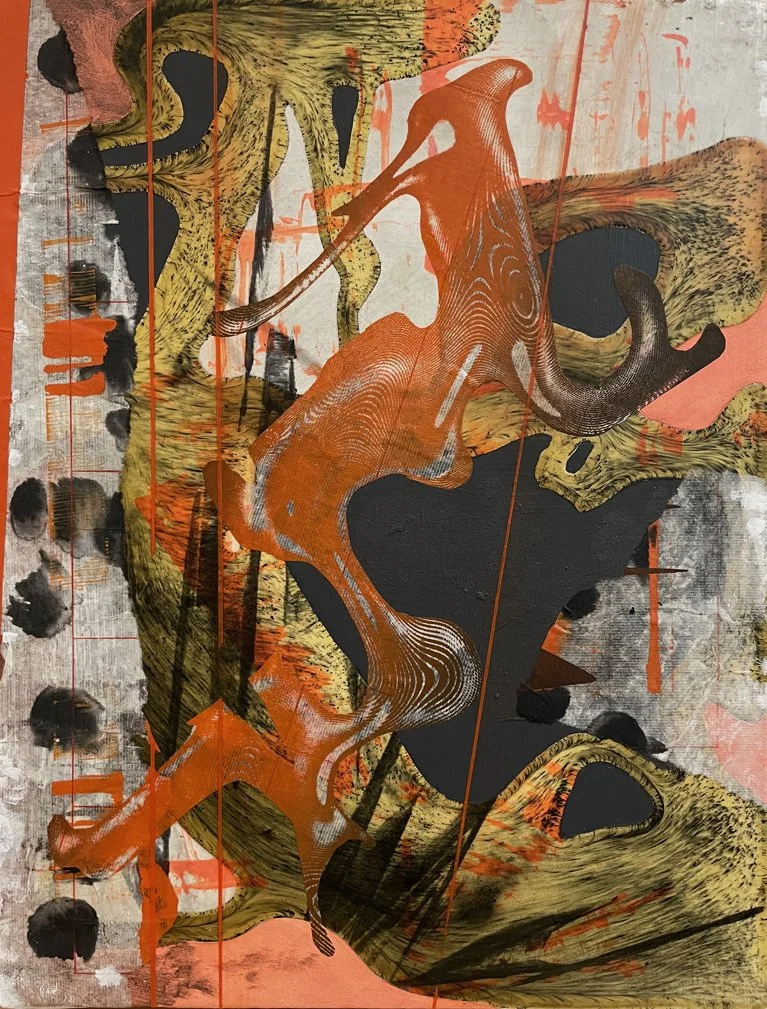
Jeffrey Bishop | Untitled WRB #5 | 2023 | Oil, Acrylic, and Collage on Panel | 16 x 12 inches | Credit: courtesy of the artist.
Rounding out my interior monologue (well, not so interior anymore), I am looking at yet another series, one presenting radically different challenges to the structural autonomy of their central forms, now often enmeshed in noisier, more chaotic compositions. What I observe is a different kind of pandemonium, a visual field strewn with random juxtapositions of ill-defined entities and movements. But at the same time, consistent with the previous series, the compositions stay anchored around a prominent central figure. More crucially these figures are no longer paragons of geometrical, human-made precision. Rather these sinuous shapes allude to something more akin to Bataille’s l’informe. Briefly, his concept of l’informe, has been recruited for art criticism (e.g., Rosalind Krauss and Yves-Alain Bois, 1996) both as a nod to formlessness more generally and as a strategy to shun conventional, static, visual (or cultural) structure for a more propulsive, process-based aesthetic. Here the “process” part is less apparent, but other relevant descriptors are. Let me add, for example, feral, slithering, protean, all of which evoke something strangely alive and decidedly uncanny. This lifelike effect is further heightened by the application of white, curvy highlights that render these otherwise flat shapes into bulbous, virtual volumes.
Looking at Untitled WRB #5 and other related paintings (See Sidewinder #1), I see a significant departure from the earlier works, as they are no longer organized according to a conspicuous geometric/non-geometrical binary. Both form and field are considerably more animated and entangled, the positive and negative spaces far more ambiguous. Underpinning this ambiguity are at least three intertwined movements, including the central orange figure along with the sizable dark gray shape and the serpentine, mottled yellow, all competing for visual dominance. Even the colors function differently from the earlier pieces, as they are distributed more randomly and thus facilitating much less separation of the central figure against the surrounding bedlam.
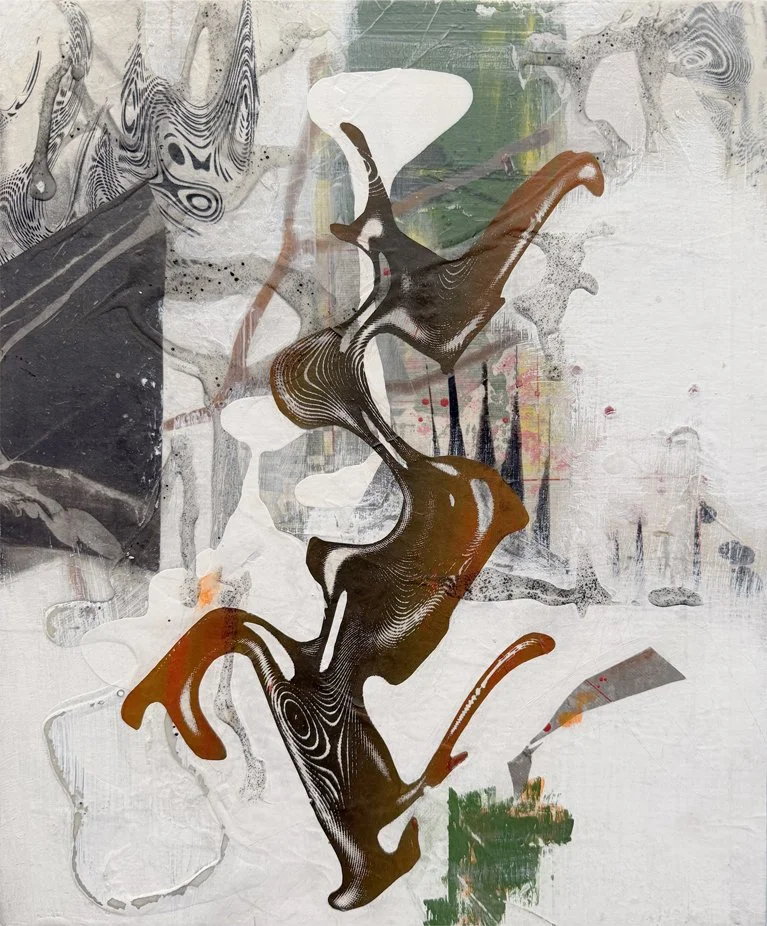
Jeffrey Bishop | Sidewinder #1 | 2024 | Acrylic and Collage on Panel | 17 x 14 inches | Credit: courtesy of the artist.
Finally I would like to wrap this up by flipping the script ever so slightly. Having focused so much on precarity, entropy, and all around gloom and doom (starting with the title of the post) I would be remiss not to acknowledge equally important qualities inherent in these works, especially the last series discussed. Seen through this different lens the first words that come to mind are exciting, dynamic, invigorating, and certainly, the opposite of boring. Who would have guessed that precarity could be fun?
Although entropy is rightfully characterized as a movement toward disorder, or, in this context, the dissolution of form, it is equally the fount of emerging possibilities, the driver of transformation. Our avatar-cum-figures have come a long way from their more rigid, closed-off iterations to ones far more fluid—formally and metaphorically operating as open systems interacting more intimately with their environment. Clearly Bishop is an artist bent on wringing out the new from the old, and so I find it especially illuminating to see this playing out across just this handful of paintings. Very much looking forward to seeing where all this goes in the years ahead.